Home base on the east bank of the Red River
Asphalt Paving in Bossier City, LA
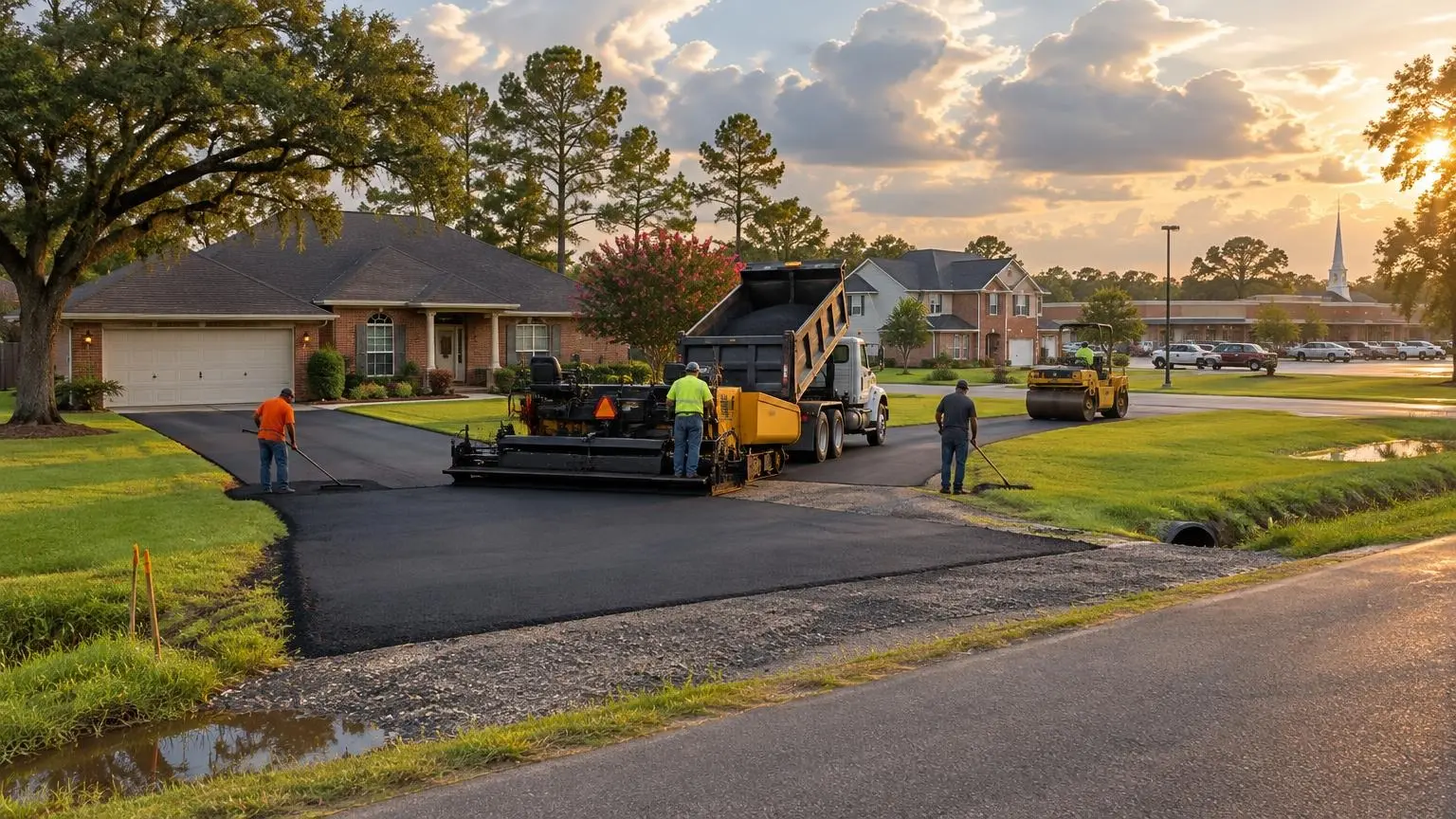
Flat ground, slow-draining clay and heavy rain shape how pavement is built here.
- Free on-site estimates
- Itemized written quote: base depth and asphalt thickness spelled out
- Drainage checked before any new asphalt is placed
Paving the East Bank
Asphalt paving in Bossier City means building on the flat east bank of the Red River, across from Shreveport. The city sits at about 164 feet of elevation, most of it level, with higher, hillier ground toward the northern city limits. Storm water leaves through the Flat River and Red Chute Bayou, and in very wet years it does not leave fast enough: flooding in March 2016 displaced more than 3,500 people. For a driveway or parking lot, that means the first questions are always where the water goes and how wet the ground underneath stays.
Neighborhoods built in waves
Bossier City grew fast in the middle of the last century. The census counted 15,470 residents in 1950, 32,776 in 1960 and 43,769 in 1970, and the city passed 62,000 by 2020. Barksdale Air Force Base, which covers more than 22,000 acres along the city's edge and was dedicated in 1933, drove much of that growth. Homes from those decades often have driveways that have been patched and overlaid more than once. When the surface is a quilt of patches and the edges are breaking into the yard, it is usually time to rebuild the base rather than add another layer.
Clay that holds water
The Bossier soil series, the USDA's reference clay for this parish, formed in Red River sediments and is described as poorly drained and very slowly permeable. Not every lot in the city sits on it, but similar heavy clays are common in the river lowlands. On those soils, we dig out soft subgrade, use more compacted stone, and slope the finished surface toward the street or ditch.
What we do in Bossier City
- New and replacement asphalt driveways
- Commercial parking lots along the busy corridors and near the river
- Resurfacing and overlays on sound pavement
- Sealcoating and crack filling
- Pothole, edge and full-depth repairs
- Parking lot striping and accessible stall layouts
Planning around the weather
The Shreveport airport normals show 51.41 inches of precipitation a year, with June the wettest month and August the driest. July highs average 93.4 degrees. We schedule base work for dry spells, start summer paving early in the day, and seal in spring and fall when the temperature sits comfortably inside the sealer's range.
Sizing a driveway job
A standard two-car driveway in town runs roughly 400 to 600 square feet, and HomeGuide's national figures put that at about $2,000 to $7,200 depending on thickness and conditions. What moves a Bossier City quote most is not the square footage but what we find under the old surface: soft clay at the street end, a crushed culvert or a base that was never there. We show you those spots before pricing the rebuild.
Streets and permits
Inside the city, we confirm the City of Bossier City's requirements for work that touches the street or the sidewalk before scheduling. Where a property fronts a state or U.S. highway, the connection falls under Louisiana DOTD's access connection permit. Call (318) 707-0717 or
.What to Know in Bossier City
- Flat, flood-prone ground. Bossier City sits at about 164 feet on the east bank of the Red River and is largely flat. The Flat River and Red Chute Bayou carry its storm water, and March 2016 flooding displaced more than 3,500 people.
- Red River clay. The USDA Bossier soil series, with its type location in Bossier Parish, is a very fine smectitic clay from Red River sediments that is poorly drained and very slowly permeable.
- Rain and heat. Shreveport airport normals (1981-2010) show 51.41 inches of precipitation over about 101 days a year and a July average high of 93.4 degrees, with a record of 110.
- Mid-century growth. The population rose from 15,470 in 1950 to 43,769 in 1970 and was 62,701 in 2020. About 53.2% of homes are owner-occupied, with a median value of $202,100 (Census, 2020-2024).
Our Services in Bossier City, LA
Bossier City Questions
Why do so many Bossier City driveways sink at the street end?
Water. The street end is where ditch water, culvert backups and runoff meet the base. On slow-draining clay, that area stays wet longest and gives way first. We fix the drainage and rebuild that part of the base before repaving.
Do you work near Barksdale?
Yes. We pave driveways and lots throughout the city, including the neighborhoods around the base. Work on the base itself follows federal procurement, which is separate from residential work.
Is fall a good time to pave in Bossier City?
Yes. Fall usually brings drier weather and milder temperatures, which suit both paving and sealing.
Do I need a city permit?
It depends on whether the work touches the street, curb or sidewalk. We confirm the current city requirements for your address before scheduling.
How long will a new driveway last in Bossier City?
Cost guides give asphalt driveways about 15 to 30 years. On well-drained ground with sealing every few years, the long end is realistic; on wet clay with no maintenance, expect the short end.
Free Estimates in Bossier City, LA
Free estimates anywhere in Bossier City.
Asphalt Paving Near Bossier City
- Asphalt Paving in Shreveport, LA
- Asphalt Paving in Benton, LA
- Asphalt Paving in Haughton, LA
- Asphalt Paving in Plain Dealing, LA
- Asphalt Paving in Red Chute, LA
- Asphalt Paving in Eastwood, LA
- Asphalt Paving in Greenwood, LA
- Asphalt Paving in Blanchard, LA
- Asphalt Paving in Vivian, LA
- Asphalt Paving in Keithville, LA
- Asphalt Paving in Stonewall, LA
- Asphalt Paving in Mansfield, LA
- Asphalt Paving in Minden, LA
- Asphalt Paving in Doyline, LA
- Asphalt Paving in Mooringsport, LA
- Asphalt Paving in Oil City, LA
- Asphalt Paving in Sibley, LA
- Asphalt Paving in Dixie Inn, LA
- Asphalt Paving in Cotton Valley, LA
- Asphalt Paving in Hosston, LA